Quick answer
Beach season in the UAE runs October to April. Outside that window, go at sunrise or after sunset only.
Why this matters more for a dog than for you: Sand gets far hotter than the air above it, and a dog walks on it barefoot. See the five-second test before your next trip.
What the heat does at each stage of a beach trip
Heat is not one problem, it is four, and they arrive at different points in the day. Laid out in the order you meet them:
| When | The hazard | What prevents it |
|---|---|---|
| Car park to sand | Paw burns on asphalt and dry sand | The five-second test, and carrying the dog |
| First 20 minutes | Rising core temperature | Shade, water, and stopping before the dog wants to |
| In and after the water | Salt water ingestion | Fresh water available the whole time |
| Hours to days after | Sand impaction from swallowed sand | Discouraging digging and fetch on dry sand |
The last row is the one people have not heard of. The Schwarzman Animal Medical Center describes sand impaction as “a life-threatening condition that occurs when a dog ingests too much sand, often accidentally, while playing on the beach”, and the trap is the delay: signs can appear anywhere from a few hours to a few days later. If your dog is off its food and lethargic two days after a beach trip, tell the vet about the beach.
The season
October to April is the sensible window — comfortable for a dog for most of the day. May to September is a different proposition: go at sunrise or after sunset only. Daytime heat in the peak months is severe enough that a midday beach trip is not a judgement call, it’s a risk.
The sand is the real hazard, not just the air
Sand absorbs and radiates heat far more than the temperature you’d guess from how hot the day feels. A dog’s paw pads make direct contact with it, unlike your own feet in shoes. Before letting a dog walk any distance on open sand, use the five-second hand test.
Heat stroke: recognising it, in order
This is the one that kills, and it is worth knowing the sequence before you need it, because the early stages look like a dog enjoying itself. Veterinary Partner puts the threshold precisely: a dog’s normal body temperature is around 101.5°F, and “any time the body temperature is higher than 105°F, a true emergency exists”.
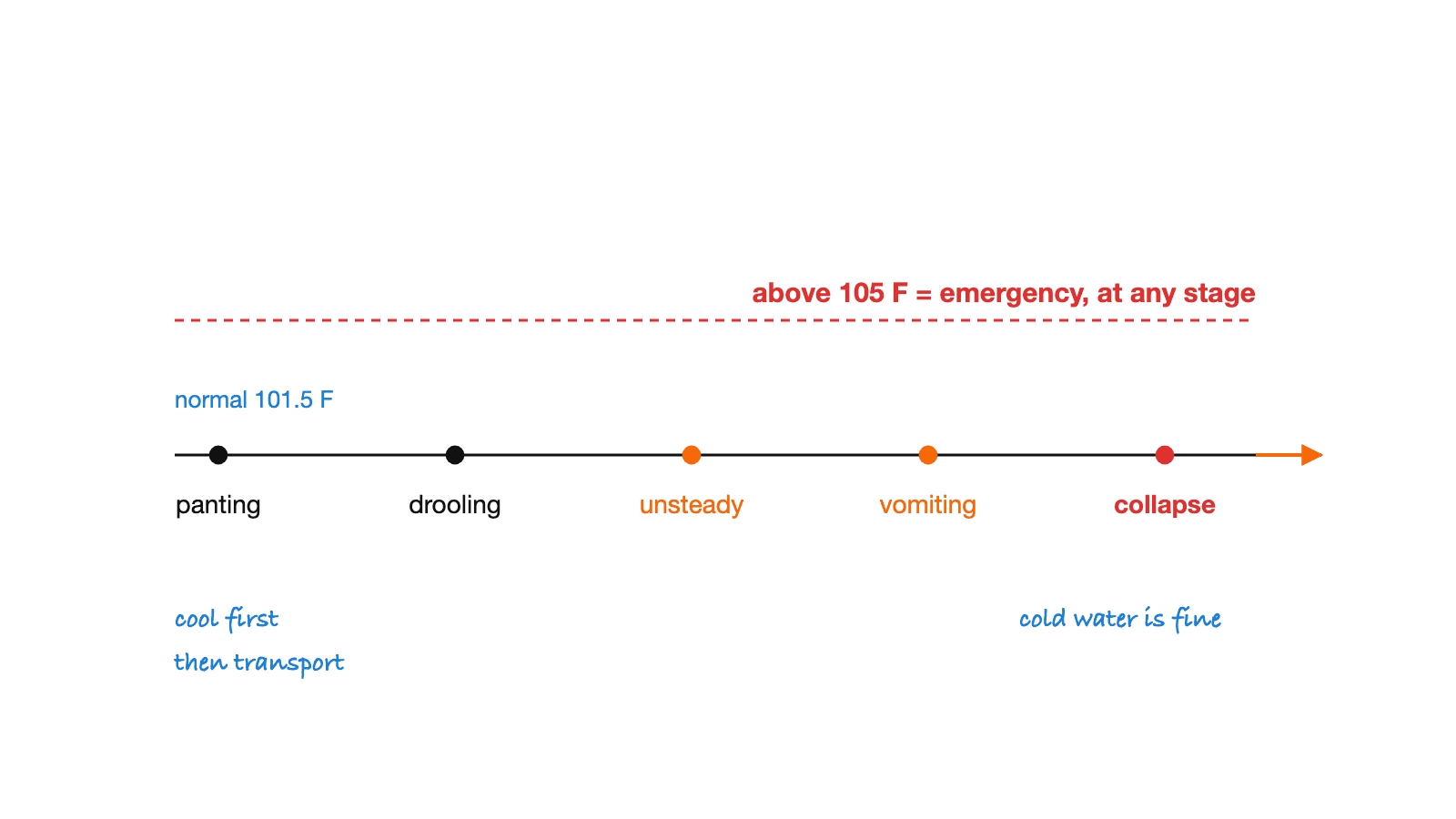
The progression runs excessive panting and restlessness, then heavy drooling, then unsteadiness, then vomiting or diarrhoea, then collapse. You do not wait to see the later ones. Note what the figure deliberately does not claim: no source maps a particular sign to a particular temperature, so we do not draw that line either.
The cold water myth, and why it is worth unlearning
Almost every UAE dog guide repeats a warning that cooling a dog with cold water causes shock. Current veterinary sources do not support it, and this is the single most useful thing on this page. Veterinary Partner calls the idea “mostly a myth”. The RSPCA states plainly that “cold water rarely causes shock”. A 2023 VetCompass study traced the belief back to a single old laboratory study, and found that the method most commonly used in practice — wet towels, in 51.31% of cases — is among the least effective ways to bring a dog’s temperature down.
Three independent sources also agree on the order of operations, which is the part people get backwards under pressure: cool first, then transport. Driving a hot dog across Dubai before starting to cool it is the wrong way round.
One honest caveat, stated the same way we would state it about a beach: this is general veterinary guidance from named bodies, not UAE-specific protocol. No UAE veterinary protocol for canine heat stroke has been published — we looked. What is local is the exposure, not the medicine.
Sea water is not drinking water
A hot dog will drink what is in front of it, and on a beach that is salt water. The Merck Veterinary Manual records the exact route: dogs “have been reported to develop hypernatremia after swimming or playing in the ocean (which contains ~3.5% sodium) without having access to fresh water”. Signs are vomiting within a few hours, then weakness, diarrhoea, muscle tremors and seizures.
The counter-intuitive part is the fix. Do not let a dog in that state drink unlimited water to correct it, because bringing sodium down too fast risks cerebral oedema. Merck is also clear about the prevention, which is trivial and is the reason water is first on the list below: salt toxicosis “is unlikely to occur as long as sodium-regulating mechanisms are intact and fresh drinking water is available”. Bring more than you think you need.
What to bring
- More water than you think, plus a collapsible bowl
- Shade — a lot of UAE beaches have little natural cover
- A towel — salt water needs rinsing off, and most beaches have no dog-wash facilities
- Waste bags and a leash — a leash is mandatory at almost every beach on this site
See the full gear guide for paw protection options and what else is worth packing.
Breed-specific and health-condition guidance not yet written
Brachycephalic breeds, senior dogs, and dogs with existing health conditions generally need more caution in heat than the general guidance above covers. We have not researched breed-specific or condition-specific thresholds for this climate and won’t publish numbers we can’t back up — if in doubt, ask a vet before a summer beach trip.
Frequently asked questions
When is it safe to take a dog to a UAE beach?
October through April is the comfortable window for most of the day. Outside that, treat sunrise and sunset as the only sensible times — daytime heat and sand temperature become a real hazard.
How do I know if the sand is too hot for my dog?
Press the back of your hand to the sand and hold it for five seconds. If you can't keep it there, your dog can't walk on it. See the dedicated hot sand and paw safety page for more on this test.
What should I bring to keep a dog cool at the beach?
More water than you think, a collapsible bowl, portable shade, and a towel for after a swim. See the checklist on this page and the full gear guide for the rest.