Quick answer
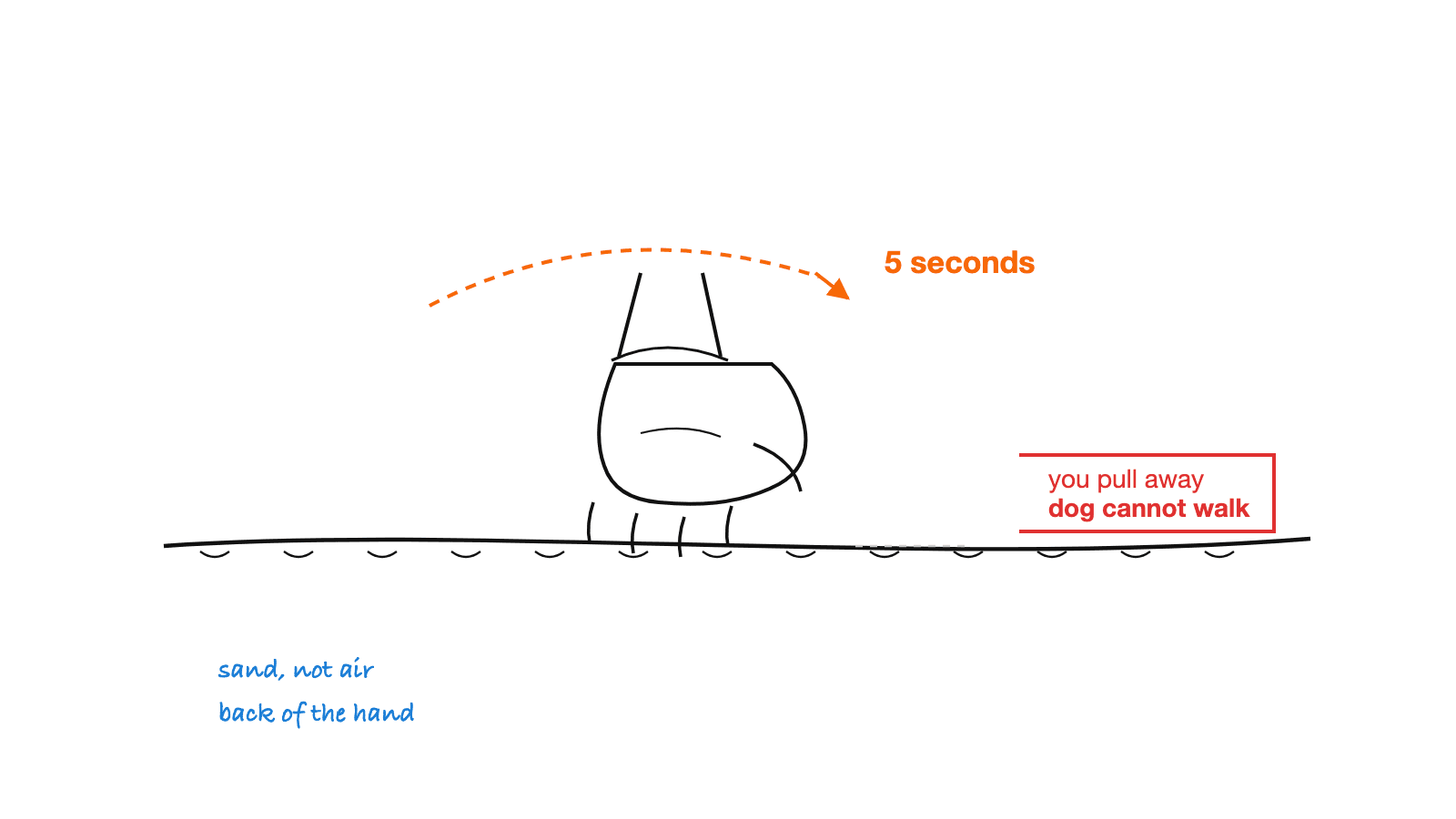
If you cannot hold the back of your hand on the sand for five seconds, your dog cannot walk on it.
The mistake people make: Testing the sand once at the car park and assuming the rest of the beach is the same. Open sand in direct sun can be hotter than shaded or damp sand a few metres away — test where your dog will actually be walking.
The five-second test
Press the back of your hand flat to the sand and hold it there for five seconds. If you cannot keep it there for the full five seconds, the sand is too hot for your dog to walk on — full stop, regardless of how short the walk to the water looks.
No exceptions. Not for a short walk, not for a dog that “seems fine.” Paw pad burns happen quickly and are painful injuries, not a minor discomfort.
Why UAE sand is a genuine hazard
Open sand in direct sun absorbs and holds heat well beyond what the air temperature suggests, and most UAE beaches have long, exposed stretches with little natural shade between the car park and the water. A dog’s paw pads sit in direct contact with it — there’s no equivalent of the shoes protecting your own feet.
The American Animal Hospital Association puts a number on the gap that makes this counter-intuitive: surface temperature can run “40 to 60 degrees more” than the air temperature, and it names sand explicitly alongside asphalt, concrete, metal and artificial turf. That is why an air temperature you personally find tolerable tells you nothing useful. The only measurement that matters is the one taken on the surface your dog will actually stand on.
We should be straight about what is and is not local here. No UAE government, academic or veterinary source publishes a measured sand-surface temperature for any UAE beach — we looked, and it does not exist. The AAHA figure is general guidance from a veterinary body, not a UAE reading, and the reason it still matters is that the physics does not care which country the sand is in. What is genuinely local is the exposure: long unshaded stretches, and a season that runs hot for far more of the year than the guidance was written for.
How to tell your dog has already burned
Paw burns are frequently missed, because a dog will keep walking on a damaged pad and the damage is on a surface you do not routinely look at. The AAHA lists the signs to watch for, and every one of them is behavioural rather than visible at a glance:
- Limping, or refusing to walk. “If your pet is suddenly reluctant to walk or is limping, they may have burned their paws.”
- Licking or chewing at the paws, more than the usual grooming.
- Pads that look darker than normal, or visibly red. Compare against a pad on a paw that has had less contact.
- Missing pad surface, or blisters. This is the point at which it is a veterinary visit, not a home problem.
On treatment the veterinary sources genuinely disagree, and we would rather show you that than pick one and sound confident. The AAHA suggests a vet-recommended ointment; Veterinary Partner says apply no ointments at all. Both agree without qualification on the first step, which is the one that matters most: get the dog off the hot surface immediately, and cool the pads. If a pad has lost surface or blistered, that is a vet.
What the surface underfoot actually costs you
Not all of a beach is one surface, and the difference between them is the difference between a walk and an injury. This is the mental model worth carrying:
| Surface | Relative risk | What to do |
|---|---|---|
| Car park asphalt | Highest | Carry the dog. Named by AAHA alongside sand. |
| Dry open sand, direct sun | High | Test it. This is what the five seconds is for. |
| Dry sand, shaded | Lower, but test anyway | Shade moves. What was shaded at 09:00 is not at 11:00. |
| Wet sand at the waterline | Lowest | Walk here where the beach allows it. |
| Promenade or decking | Varies, often high | Composite decking and metal both hold heat. |
The ordering here is the AAHA’s list of surfaces that become dangerously hot, applied to what a UAE beach actually consists of. The relative column is a judgement about ordering, not a measured figure, and we are not going to give you numbers nobody has published.
What to do if the sand fails the test
- Go earlier or later — the best time of year page covers the seasonal window in full.
- Carry your dog across exposed sand rather than letting them walk it.
- Stick to wet sand near the waterline where possible — it runs cooler than dry sand further back.
Boots, balm, and what actually works
Paw balm and boots both come up constantly, and they solve different problems. Balm conditions the pad and offers some protection against drying and cracking; it does not make a pad heatproof, and treating it as armour is how dogs get burned by owners who thought they had covered it. Boots do genuinely insulate, and the honest catch is that a lot of dogs will not tolerate them without a patient introduction well before the day you need them.
Neither replaces the test. If the sand fails five seconds, the answer is not better equipment, it is a different time of day. Our dog beach gear page covers what to carry, and it carries no affiliate links and recommends no specific products — we have nothing to sell you here.
When a burn becomes an emergency
A burned pad is painful but rarely life-threatening on its own. What makes hot sand dangerous in the UAE is that the same conditions producing it also produce heat stroke, and that one kills. If your dog is limping and panting heavily, unsteady, drooling excessively or has vomited, stop treating it as a paw problem. Our dog beach first aid page covers the recognition sequence and carries a directory of UAE emergency vets, split by whether the clinic is genuinely open around the clock or merely advertises that it is.
Specific temperature figures and paw-burn research not yet sourced
We deliberately don’t quote a specific sand or air temperature threshold, or describe what a paw burn looks like or how to treat one, because we have not sourced that from a veterinary reference for this climate specifically. The five-second test above doesn’t need a number to be reliable — if in doubt, treat it as too hot.
Frequently asked questions
How do I test if sand is too hot for my dog?
Press the back of your hand flat against the sand and hold it there for five seconds. If you have to pull away before five seconds is up, the sand is too hot for your dog to walk on — no exceptions, and no “it's just a short walk.”
Why does sand get hotter than the air feels?
Sand absorbs and radiates direct sun far more than the surrounding air temperature suggests, and there's usually little shade over open beach sand. A dog's paw pads make direct contact with it, unlike your own feet in shoes.
What times of day is the sand generally safe?
Sunrise and shortly after, or after sunset, are the safest bet outside the October-to-April season. See the best time of year page for the full seasonal breakdown.